Sunday, March 26, 2006

Mortician Requirements In Florida

A HUMANIST


JOSE DE ACOSTA (n. Medina del Campo, 1540 - m. Salamanca, 1600)

studied at Salamanca and Alcalá de Henares, and in 1572 was sent to Peru by the Society of Jesus. He taught theology in Lima and held various church offices in the colony, in 1576 he was appointed provincial of the order and founded several colleges across the length and breadth of the country, traveling constantly for him, thus gaining a great knowledge of Peruvian land and its people then usher in their writings. In 1583 participates in the Third Council of Lima, where Christian doctrine is translated into Quechua and Aymara, to facilitate the evangelization of the Indians. Acosta left Peru in 1585 Mexico Road, where he remained for 3 years before returning to Spain. In 1592 he traveled to Rome to defend their reformist ideas based on what he had seen and lived in the Americas, in opposition to General Order in the V Congregation of the Society of Jesus. But the order is finally sided with the General, so that Acosta was disgraced and had to return beaten Spain. In 1597 he was appointed rector at the College of Salamanca, where he died in February 1600.
Fray José de Acosta, and one of the advocates of the Indians during the colonial period, was undoubtedly a humanist and scientific precursor of modern thought and of geography as we know it today. Among his works, and apart from a lavish production theological stand Salute Indorum De Procuranda (1588) and De enactment Evangelii apud Barbaros (1588) on its work of evangelization in America, in which he criticized the way in which secular and religious led some English in the colonies and their difficult behavior preach something totally opposite of what the Indians saw every day, although many of these criticisms were censored before publication of the work. However, as Fray José attain global recognition would be by two of his works: De Natura Novi Orbis (1588) and, above all, his Natural and Moral History of the Indies (1590). Fray José summarized them practically new geographical knowledge that had emerged from the findings and criticized the old notions of geography based on Greco-Roman classics and the Bible. While one can say that it is easy to talk for example about the roundness of the earth after trip Magallanes, the work of the Jesuit is full of other extrapolations from what was known at that time which later proved very successful such as the existence of Australia or the idea that the Indians came to America from Asia by a narrow strip of land or that should unite the two continents to the north and would not be discovered until 1728 by the Danish Vitus Bering :

"This speech I have said is for me a big assumption to think that the new world, we call India, divisive and not entirely separate from another world. And tell me, I have for me days ago, the earth and the other one somewhere else, together, and continue, or at least far ahead and comers. So far at least there is no certainty to the contrary. Because the Arctic pole, called North, it is discovered and known throughout the length of the earth ... "

Acosta also did not believe in his work (giving all sorts of explanations that today strike us as more rational ) of classic such as the Atlantis of Plato, which would have left the people of America, or that American Indians came from the lost tribes of Israel , according to some basis in the Bible, and others simply ridiculed like the idea of \u200b\u200bSt. Augustine that if the earth was round the antipodes should live upside down. Acosta was thus a precursor of the new science is going to leave behind the principle of authority of the classics and, above all, of the Holy Scriptures to base their knowledge on everything on our own experience and reason, and it is strange to think that a XVI century Jesuit could have a more open mind Some people in our brand new century, who refuse to see beyond what the Bible says.

Saturday, March 18, 2006

Stretchedlabia.bolgspot.com


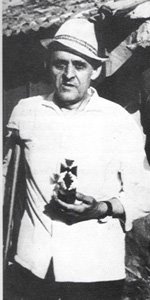
SATURNINO OF LUCAS (n. Mudrián, 1911 - m. Mudrián, 1970)

The condemnation from the Council of Europe of the Franco dictatorship and to recommend measures such as declaring the July 18 day dedicated to the victims or to the Valley of the Fallen a memorial museum came yesterday to join what many voices have been calling for some time from our country, ie to stop distorting the truth about what were 40 years of brutal dictatorship that left Spain orphan children some of their most prominent . The Franco regime was not a "soft dictatorship" necessary as some say, or democracy as almost a sure others, was an authoritarian regime that began with the murder of thousands opponents and forced many more into exile abroad or In many cases, in their own country, forced into silence by fear of death. Internal exile even reached some of the "winners" whose ideals did not expect that brought victory bring. Perhaps the most glaring victim of that internal exile were called moles. Buried alive by the terror of being murdered in the wall a cemetery, many of them, who were leaders or simply supporters of leftist parties, began to come to light in the late 60's and early 70's with successive amnesty decrees, as the Republican mayor of the village Mudrián Segovia, who returned to life after 34 years.
Saturnino de Lucas, the second of eight children, was born into a poor family of resin. From the fifteen months was crippled by polio, yet they had to start working from 6 years since he earned his father gave to support the family. Despite his disability for which he received the nickname "the lame", he worked in the resin as their elders, and chipping, swineherd and messenger of the people. Although he had little opportunity to attend school, their teachers then were fixed on him and tried to study, but the enmity of his father Juan Marcelo del Campo, the mayor and chief of the village, made it even refuse scholarships requiring that the teacher not to admit him in school. However, thanks to the classes that the same teacher gave his fans boo and the studio got a basic education that earned him several jobs for an insurance salesman and agent throughout the region who had at the same time that the office that cobbler. In addition, interest in the law, and although time and again Mayor Mudrián denied the grants applied for him by the priest and the teacher did not know enough to represent the working poor in the region in multiple lawsuits, which he alienated most of the chiefs of the area. He even make a competition for village secretary of Toledo Torrijos, but could not take possession of the place by not having 25. His defense of the workers will be getting charges made in their organizations, but does not like politics because more than anything was an idealist. In 1933 he was appointed president of the UGT in the area, and in 1936 Delegate of the Popular Front. Finally he was appointed mayor by the governor Mudrián Segovia had Marcelo del Campo deposed for alleged embezzlement.
At the beginning of civil war Saturnino de Lucas remained in his post despite Segovia quickly opted by the rebels. In the early days came in the village a group of workers Cuéllar with intent to murder the priest. Saturnino's faced and saved his life the pastor, with whom he had always gotten along since he was a religious man and that Mudrián, unlike many other places, the priests had supported almost always against the lowly chiefs . On July 24 that appeared were a group of Falangists another nearby town seeking the mayor because the chiefs of the area had given 60,000 pesetas for his head. They searched all over town, even took his family and friends to be tortured, but did not find him. The lame was where nobody looked. His friendship with the priest that earned him back the favor by hiding in the trunk of a block from the church where she was held until 1940. For nearly four years remained hidden by the priest, living all day in the chest and out only at night to smoke and chat with the priest. But the years of hiding his friend took their toll on the mind of the priest, who eventually lost his head and was about to discover. In February 1940 he had to leave his hiding place, hiding in his house parents. Went to live in a garret of two by four meters in which it was impossible to stand up and whose only contact with the outside world was hidden in a small opening adobe murillo by feeding him and furnish him what he needed. With a small typewriter and a radio went blind even the wives of his brothers and his nephews the next thirty years, enduring temperatures of more than 50 º C in summer and below -20 º C in winter, living experiences as the death of her mother in 1959 or the constant fear of the frequent records of the house by the Falange and civil guards in the sole company of his books and his brothers at night from the other side of the wall. Despite their situation, continued to conduct their business of commercial agent by his brothers and a diary, a novel or even a treaty of magic, which was very fond.
finally emerged from his confinement on April 30, 1970 after the general amnesty. His health was not good, and when interviewed by Jesus Manuel Torbado and Leguineche for his book "The mole" (El País-Aguilar) was a man used to live in darkness accompanied only by his thoughts. Rambled and was anxious to tell the world everything he had discovered in his years of solitude: techniques of suggestion and read strange cures out there (he to him only 5 teeth removed), the secret to world peace. His image was that of a Don Quixote who had had years to read too, but despite some oddities like those in general had been better informed about what was happening in the world that his brothers and nephews, more concerned with daily life. He died on December 6, just over seven months after leaving his makeshift cell.
in his book Leguineche Torbado and that even in 1970 when he learned that the cripple lived, Juan Marcelo del Campo walked the streets of the town whispering: "You have to kill, must kill!

Monday, March 13, 2006

Non Itchy Ras Behind Both Knees

Mudrián MAYOR OF THE PROCEEDINGS LOST THE GRAND MUFTI


Since Saturday
regular readers of the blog you can read if you want in http://www.librodenotas.com/ a new column that aims to be something like this blog but which I hope to have some interesting stories without limitation imposed by the biographies. The column in question will come from 11 of each month, which means the blog will not disappear. You can find it in http://www.librodenotas.com/losanalesperdidos/ The first deals with the English diplomat Sanz Briz and the Jewish question in the Franco era. Hope you like it.
Jose Antonio del Valle