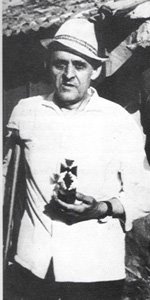
SATURNINO OF LUCAS (n. Mudrián, 1911 - m. Mudrián, 1970)
The condemnation from the Council of Europe of the Franco dictatorship and to recommend measures such as declaring the July 18 day dedicated to the victims or to the Valley of the Fallen a memorial museum came yesterday to join what many voices have been calling for some time from our country, ie to stop distorting the truth about what were 40 years of brutal dictatorship that left Spain orphan children some of their most prominent . The Franco regime was not a "soft dictatorship" necessary as some say, or democracy as almost a sure others, was an authoritarian regime that began with the murder of thousands opponents and forced many more into exile abroad or In many cases, in their own country, forced into silence by fear of death. Internal exile even reached some of the "winners" whose ideals did not expect that brought victory bring. Perhaps the most glaring victim of that internal exile were called moles. Buried alive by the terror of being murdered in the wall a cemetery, many of them, who were leaders or simply supporters of leftist parties, began to come to light in the late 60's and early 70's with successive amnesty decrees, as the Republican mayor of the village Mudrián Segovia, who returned to life after 34 years.
Saturnino de Lucas, the second of eight children, was born into a poor family of resin. From the fifteen months was crippled by polio, yet they had to start working from 6 years since he earned his father gave to support the family. Despite his disability for which he received the nickname "the lame", he worked in the resin as their elders, and chipping, swineherd and messenger of the people. Although he had little opportunity to attend school, their teachers then were fixed on him and tried to study, but the enmity of his father Juan Marcelo del Campo, the mayor and chief of the village, made it even refuse scholarships requiring that the teacher not to admit him in school. However, thanks to the classes that the same teacher gave his fans boo and the studio got a basic education that earned him several jobs for an insurance salesman and agent throughout the region who had at the same time that the office that cobbler. In addition, interest in the law, and although time and again Mayor Mudrián denied the grants applied for him by the priest and the teacher did not know enough to represent the working poor in the region in multiple lawsuits, which he alienated most of the chiefs of the area. He even make a competition for village secretary of Toledo Torrijos, but could not take possession of the place by not having 25. His defense of the workers will be getting charges made in their organizations, but does not like politics because more than anything was an idealist. In 1933 he was appointed president of the UGT in the area, and in 1936 Delegate of the Popular Front. Finally he was appointed mayor by the governor Mudrián Segovia had Marcelo del Campo deposed for alleged embezzlement.
At the beginning of civil war Saturnino de Lucas remained in his post despite Segovia quickly opted by the rebels. In the early days came in the village a group of workers Cuéllar with intent to murder the priest. Saturnino's faced and saved his life the pastor, with whom he had always gotten along since he was a religious man and that Mudrián, unlike many other places, the priests had supported almost always against the lowly chiefs . On July 24 that appeared were a group of Falangists another nearby town seeking the mayor because the chiefs of the area had given 60,000 pesetas for his head. They searched all over town, even took his family and friends to be tortured, but did not find him. The lame was where nobody looked. His friendship with the priest that earned him back the favor by hiding in the trunk of a block from the church where she was held until 1940. For nearly four years remained hidden by the priest, living all day in the chest and out only at night to smoke and chat with the priest. But the years of hiding his friend took their toll on the mind of the priest, who eventually lost his head and was about to discover. In February 1940 he had to leave his hiding place, hiding in his house parents. Went to live in a garret of two by four meters in which it was impossible to stand up and whose only contact with the outside world was hidden in a small opening adobe murillo by feeding him and furnish him what he needed. With a small typewriter and a radio went blind even the wives of his brothers and his nephews the next thirty years, enduring temperatures of more than 50 º C in summer and below -20 º C in winter, living experiences as the death of her mother in 1959 or the constant fear of the frequent records of the house by the Falange and civil guards in the sole company of his books and his brothers at night from the other side of the wall. Despite their situation, continued to conduct their business of commercial agent by his brothers and a diary, a novel or even a treaty of magic, which was very fond.
finally emerged from his confinement on April 30, 1970 after the general amnesty. His health was not good, and when interviewed by Jesus Manuel Torbado and Leguineche for his book "The mole" (El País-Aguilar) was a man used to live in darkness accompanied only by his thoughts. Rambled and was anxious to tell the world everything he had discovered in his years of solitude: techniques of suggestion and read strange cures out there (he to him only 5 teeth removed), the secret to world peace. His image was that of a Don Quixote who had had years to read too, but despite some oddities like those in general had been better informed about what was happening in the world that his brothers and nephews, more concerned with daily life. He died on December 6, just over seven months after leaving his makeshift cell.
in his book Leguineche Torbado and that even in 1970 when he learned that the cripple lived, Juan Marcelo del Campo walked the streets of the town whispering: "You have to kill, must kill!


